
Superheroes and the Beginner's Guide to Politics
(Why their narratives can be powerful tools of both storytelling and crowd mobilisation)

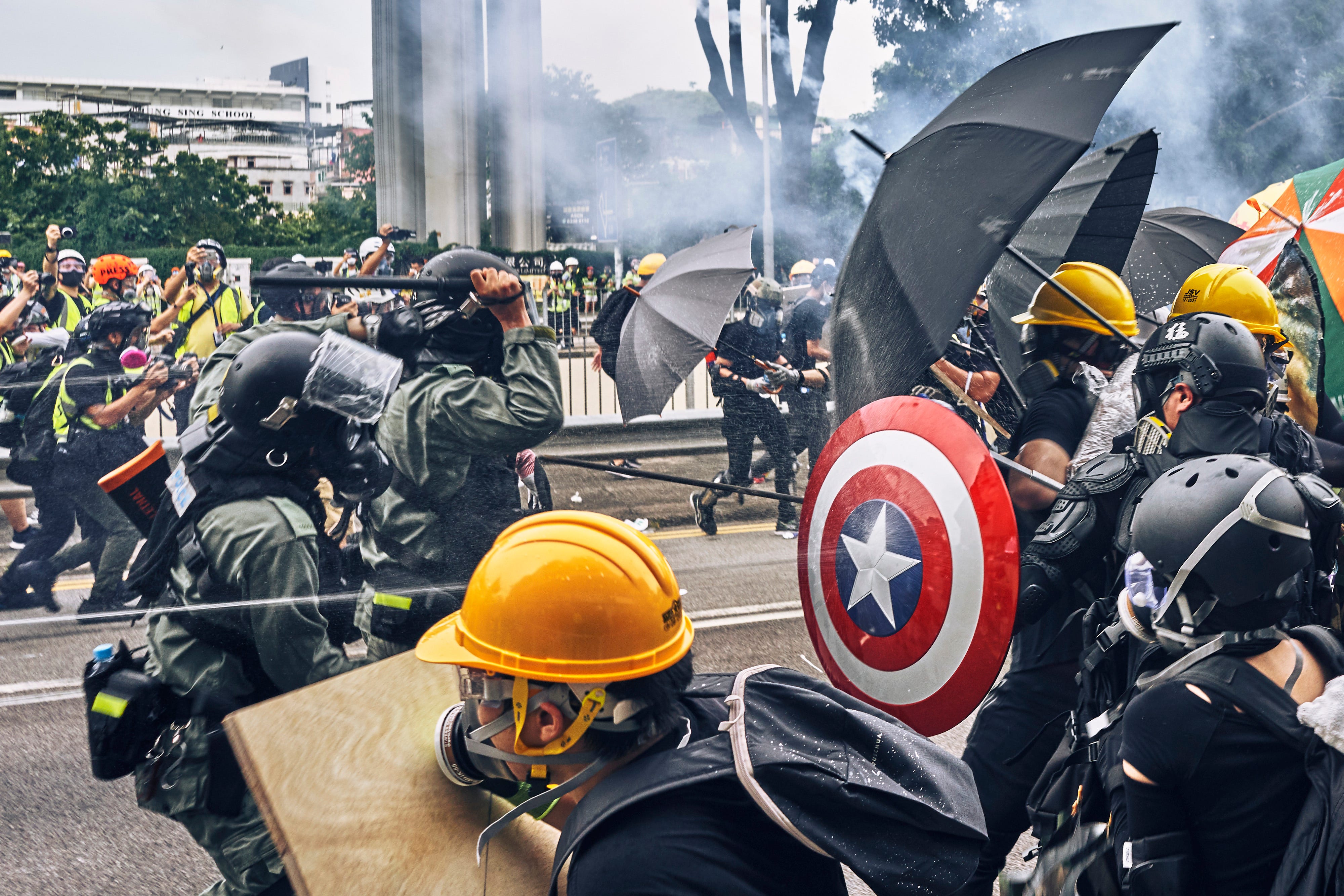
cr: An Rong Xu / Redux from this MIT Technology Review article.
Rania, Doha, Mar 31st.
The contribution of superhero narratives to political discourse is something that's always been there, but only recently has it found itself in mainstream or formal academic discourse. This phenomenon probably owes itself to both the modern explosion of commercialisation of superhero franchises as well as the increased coverage of political unrest everywhere around the globe.
(Just to be clear, I’m specifically referring to mainstream superhero franchises, which often span across different mediums from comics to movies to merchandise or even theme parks!)
While sitting in my room and bingeing on my comfort superhero movies and TV shows, I couldn’t help but think that—aside from the personal affectations—the political element in superhero stories is an important factor to their mass appeal and longevity. In fact, in some countries where the national identity is so rooted in the “super-heroic sense of confidence”1, it wouldn’t be a reach to say these characters can easily become “embedded in the cultural psyche”2.
In fact, the existing academic literature out there puts up little resistance against the argument that political undertones do exist within superhero stories. Rather, superhero narratives are thought to be “most evocative and popular when they respond to turbulent political times… especially those of war and civil unrest.”3 For instance, the stories of X-Men—super-powered mutants ill-provided-for and shunned by institutions—allegorically represent disenfranchised groups in our society, and their struggles often reflect the struggles of those marginalised by their race, class, sexuality, disabilities, religion and more. The evils that the X-Men fight against are thus indicative of repressive social norms (racism, sexism, xenophobia), and the personal conflicts within these superheroes potentially offer insights on the intersection of political affiliation and personal identity.
It’s an interesting question to ask: in what other ways have superhero franchises played a role in our lives aside from momentary reprieve of reality—a form of simple entertainment?
Historically, super-heroic images have been used as icons, especially in nationalist struggles to represent territorial safety and support for collective identities4. Some recent examples I can think of are from Hong Kong, where superheroes were widely used as subversive icons during their political resistance against mainland communist values in favour of establishing their own democratic identity and social justice. Anti-authoritarian ‘superhero’ narratives, such as the Matrix trilogy, were also used widely during the student-led Umbrella Revolution as propaganda to mark Hong Kong’s distinction from the Chinese socialist identity. Meanwhile, renditions of Attack on Titans, reimagined as Attack on China (where the unwelcome ‘China’ replaced the villains ‘Titans’), represented the perceived dystopian future under Chinese rule. Trends like these suggest that superhero narrative or characters can prove to be effective tools of communicating ideologies—and in some cases, powerful enough to mobilise crowds.
Another interesting pattern materialising involves institutional spaces. These spaces are traditionally dominated by high-ranked elites and occupied by their interests—and in recent years, their reach has not receded in the slightest, but rather expanded exponentially. The wary public thus has come to realise that they must carve out new spaces for political deliberation, leading to the rise of unconventional forms of political participation5. Over the years (in part thanks to social media and mass cinema) global fanbases for superhero franchises have opened up platforms for discussions of topics, where fan-spaces have seen high levels of civic engagement and political discourse. The quality of these discourses, of course, is another topic entirely, but the fact that these conversations may be galvanised by specific works of fiction in the first place is one to be noted.
We often speak of our times as the 'Golden Age of Content'. The sheer volume of media we consume is so large, the range of topics covered so fast, and overtime each one is placed under heavier and heavier scrutiny for both their impact and contribution to social commentaries. Often, there is a concern that such rapid consumption of media is desensitising us to the ‘real world’ or current affairs.
We must remember that modern politics is not only new, but also complicated. As someone who only barely scratched the surface of this world in three years of university education, I understand the need for entertainment mediums and their power to package complexities into easily understandable and more appealing formats through the use of light language, satire, or dramatisation.
Rather than causing disengagement from public life, I think popular culture is increasingly being used as a “resource” with which young people are navigating themselves (and their civic duties) around this hostile and hazily complicated world we like to call ‘politics’.
Hagley, A. (2016, March 28). America's Need for Superheroes Has Led to the Rise of Donald Trump
Costello, M. J. and Worcester, K. (2014) The Politics of the Superhero: Introduction, PS: Political Science & Politics
DiPaolo, M. (2011). War, Politics and Superheroes: Ethics and Propaganda in Comics and Film
Dittmer, J. (2013). Captain America and the Nationalist Superhero: Metaphors, Narratives, and Geopolitics
Rosanvallon, P. (2008). Counter-democracy: Politics in an Age of Distrust